Computer Lab Management Software for Secure and Efficient Lab Operations
Educational institutions face growing challenges in managing shared computer labs, including workstation security, software licensing, staffing, scheduling, and resource utilization. VeraLab helps universities, schools, and libraries automate lab operations through centralized workstation management, access control, usage monitoring, reporting, and analytics.
Here we will explain how VeraLab addresses these aspects
- Managing Modern Computer Labs
- The Challenges of Managing Modern Computer Labs
- The Solution: Computer Lab Management System
- VeraLab — Integrated Computer Lab Management Platform
- Access Control & Security
- Maintenance & Issue Management
- Employee Supervision & Attendance Tracking
- Management Analytics & Decision Support
-
Managing Modern Computer Labs
Computer labs often span multiple rooms and locations across a campus. Administrators must manage workstation availability, user authentication, software access, staffing, maintenance, and security while supporting large numbers of students and faculty.
The lab is supervised by a Lab Manager or Lab Coordinator, who is responsible for overall lab performance, carries out day-to-day management duties, and plays an active role in budgeting, staffing, purchasing, payroll, and other money-related matters.
Labs hire Technicians, employees responsible for the overall condition and availability of the equipment. Technicians conduct complex repairs, maintain stock of spare parts, order and install software, communicate with vendors' technical support services, and perform other technical tasks.
Labs also hire a number of Lab Assistants, usually students working part-time. Lab Assistants supervise computer rooms operations and users sign-in, conduct technical and customer support, and perform minor troubleshooting and simple maintenance tasks.
Without automation, these tasks become time-consuming, inefficient, and difficult to scale.
-
The Challenges of Managing Modern Computer Labs
Managing campus computer labs with spreadsheets, manual processes, or disconnected tools creates operational inefficiencies, security risks, and unnecessary costs.
As institutions expand their technology infrastructure across multiple labs, buildings, and campuses, IT departments need centralized visibility and control over users, workstations, software, staffing, and support operations.
Without a dedicated lab management platform, colleges and universities often face challenges such as:
- Limited Security & User Accountability. Unauthorized or high-risk users cannot be easily identified or monitored. When security incidents occur — such as misuse of university resources, policy violations, or malicious activity — administrators often lack the audit trail needed to identify who used a workstation, when it was used, and what systems were affected.
- Inefficient Workstation & Occupancy Management. Lab staff frequently lack real-time visibility into workstation availability, room occupancy, waitlists, or scheduled classes across campus locations. As a result, computer resources are underutilized while students experience unnecessary delays and overcrowding.
- Lack of Centralized Operational Control. Without centralized management tools, staff cannot remotely lock or reserve workstations, enforce lab policies, or quickly prepare rooms for scheduled instruction. Managing multiple labs becomes increasingly difficult as institutions scale.
- Limited Visibility Into Staffing & Utilization. Many institutions lack reliable analytics on peak usage hours, staffing requirements, workstation demand, and lab traffic patterns. This makes it difficult to optimize schedules, allocate personnel efficiently, or reduce operational costs.
- Inefficient Technical Support & Maintenance. Tracking workstation issues through emails, spreadsheets, or handwritten notes leads to delayed resolution times and poor coordination between lab assistants and technical staff. Critical maintenance issues may go unresolved, directly affecting student productivity and lab availability.
- Insufficient Data for Budgeting & Strategic Planning. Without accurate reporting, decision-makers cannot effectively evaluate hardware performance, software utilization, maintenance costs, or future infrastructure needs. This limits the institution’s ability to justify budgets, optimize technology investments, and plan long-term upgrades.
Instead of relying on fragmented or homegrown solutions, institutions gain a scalable platform designed specifically for academic computer lab environments. -
The Solution: Computer Lab Management System
Implementation of a modern, fully integrated Computer Lab Management System can significantly improve the efficiency, security, and cost-effectiveness of computer lab operations across universities and colleges. A centralized platform enables IT departments and lab managers to streamline daily operations, improve resource utilization, strengthen security, and make better-informed operational decisions.
- Workstation access control, user sign-in, and security. Lab staff should be able to centrally manage workstation access, monitor occupancy in real time, maintain waitlists, and remotely lock or unlock workstations when needed. Integration with LDAP, Active Directory, or Single Sign-On (SSO) systems enables automated user authentication and comprehensive audit trails for compliance and security oversight. Administrators should also be able to maintain alert lists, identify policy violators, and analyze workstation usage history across all lab locations.
- Maintenance automation. Lab assistants and technicians require efficient tools for issue tracking, maintenance coordination, and asset management. A centralized system should allow employees to log and collaborate on technical issues, maintain workstation service histories, and mark systems as unavailable when out of service. This helps reduce downtime, improve communication between shifts, and ensure that students and faculty have access to reliable computing resources.
- Management decision support. University IT leaders and lab managers need accurate operational data to support scheduling, staffing, budgeting, and purchasing decisions. A comprehensive Computer Lab Management System should provide analytics on room occupancy, workstation utilization, waitlists, maintenance costs, software usage, and peak traffic periods. These insights help institutions optimize staffing levels, improve lab availability, justify technology investments, and plan future infrastructure needs more effectively.
VeraLab provides a comprehensive Computer Lab Management System purpose-built for academic environments, combining security, occupancy management, maintenance automation, reporting, and operational analytics into a single integrated platform for higher education institutions.
-
VeraLab — Integrated Computer Lab Management Platform
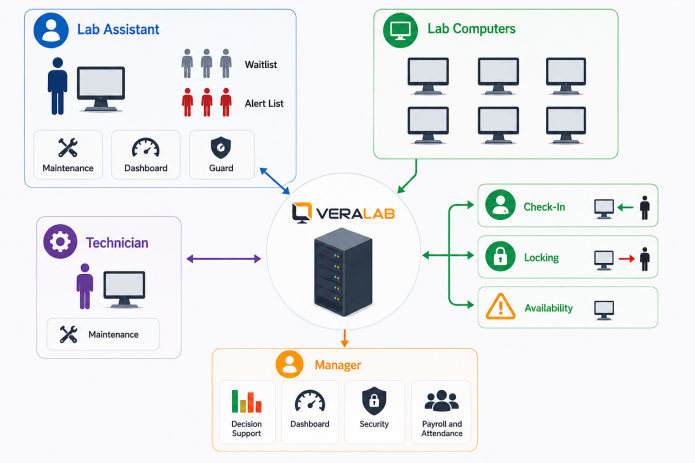
VeraLab is an enterprise-grade Computer Lab Management System designed for higher education institutions. The platform centralizes workstation management, user access control, occupancy monitoring, maintenance automation, reporting, and operational analytics into a single integrated solution.
Figure 1. VeraLab addresses all major business processes in a computer lab.
By replacing manual processes and disconnected tools, VeraLab enables universities and colleges to improve operational efficiency, strengthen security, optimize resource utilization, and deliver a better student computing experience across campus computer labs.
The illustration below highlights the core operational processes managed through the VeraLab platform.
-
Access Control & Security
VeraLab provides centralized access control and security management for academic computer labs, helping institutions improve workstation security, enforce lab policies, and maintain full visibility into user activity across campus environments.
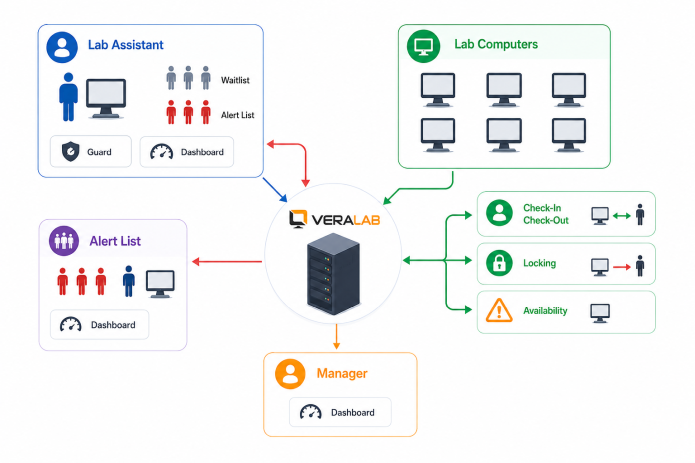
Figure 2. Access control and security. Lab staff manage workstation access, waitlists, and user verification, while managers monitor lab activity and security through centralized dashboards.
Lab assistants can quickly sign users in and out through the Lab Assistant Dashboard using student ID cards, barcode scanners, or institutional authentication systems. During the sign-in process, the system automatically validates users against configurable alert and restriction lists, helping staff identify policy violators or high-risk users before workstation access is granted.
Rooms can be reserved for scheduled classes, exams, or special sessions, with configurable policies that allow or restrict outside users during reserved periods. Staff can remotely lock or unlock individual workstations — or entire rooms — directly from the central management console to prevent unauthorized use and ensure labs are prepared for instruction.
When labs reach capacity, staff can view real-time workstation availability across multiple rooms and redirect users to alternative locations. VeraLab also supports intelligent waitlists based on workstation type, room preference, or specific equipment requirements, improving resource utilization and reducing student wait times.
Managers and administrators can monitor room occupancy, workstation status, and user activity remotely through the Manager Dashboard. Because VeraLab is web-based and centrally managed, supervisory staff can oversee operations across multiple labs and campus locations without needing to be physically present.
Comprehensive access logs and activity history provide institutions with the audit trail needed to investigate security incidents, identify policy violations, and maintain accountability for workstation usage.
Together, these access control and security capabilities help transform computer labs into efficient, centrally managed environments with minimal administrative overhead and enhanced operational security. To learn more, read the white paper Establishing a Secure Lab Environment.
-
Maintenance & Issue Management
VeraLab includes an integrated Issue Tracking and Maintenance Management system that helps universities streamline technical support operations, reduce workstation downtime, and improve communication between lab staff and IT technicians.
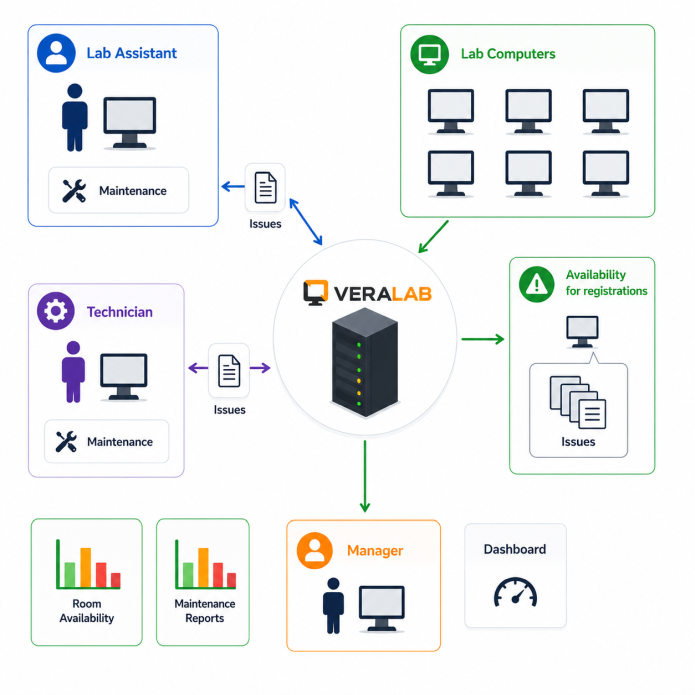
Figure 3. Maintenance & Issue Management. The system tracks workstation issues, enables staff collaboration on maintenance tasks, automatically removes unavailable systems from service, and provides managers with real-time status and historical maintenance data.
Lab assistants and technicians can log, track, and manage hardware or software issues through a centralized maintenance platform fully integrated with the rest of the VeraLab system. When a workstation is marked with a critical or “out-of-service” issue, the system can automatically remove it from availability, preventing users from signing in until the issue is resolved. Managers and support staff can monitor workstation availability and maintenance status in real time across all lab locations.
The platform improves collaboration between lab personnel and technical staff through automated workflows and notifications. Technicians receive email alerts when new issues are reported, can review open tickets at the start of their shifts, request additional information when needed, and maintain issue histories through integrated discussion threads and activity logs.
In addition to improving operational efficiency, VeraLab provides valuable maintenance analytics and decision support capabilities. Because every issue is associated with a specific workstation and repair history, managers can analyze maintenance costs, identify recurring hardware failures, evaluate total cost of ownership, and make more informed budgeting, purchasing, and infrastructure planning decisions.
-
Employee Supervision & Attendance Tracking
VeraLab helps universities streamline employee supervision and attendance tracking for lab assistants and other hourly staff.
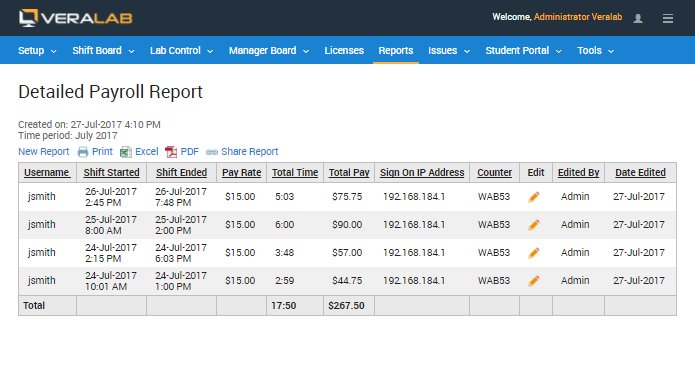
Figure 4. Lab Assistant shift reports and payroll.
Lab employees register their shifts directly through the system when starting and ending work assignments, creating accurate attendance records for operational oversight and payroll reporting. Managers can access attendance data through centralized reports to monitor staffing coverage, verify work hours, and simplify payroll calculations.
By automating attendance tracking and shift accountability, VeraLab helps institutions improve workforce management, strengthen operational discipline, and reduce administrative overhead.
-
Management Analytics & Decision Support
VeraLab continuously collects operational data across the lab environment, including workstation utilization, room occupancy, user activity, waitlists, maintenance records, repair costs, and equipment availability. This data provides university IT leaders and lab managers with actionable insights for operational planning, budgeting, and resource optimization.
- Room scheduling and staffing. Managers can analyze historical occupancy trends by day, time, and location to optimize lab schedules and staffing levels based on actual demand. This helps institutions improve personnel allocation, identify peak usage periods, and minimize the impact of reduced operating hours by targeting periods of low utilization.
- Purchasing and budget planning. VeraLab provides visibility into maintenance costs, equipment reliability, and total cost of ownership by workstation type. Managers can identify hardware with excessive maintenance requirements, forecast future support expenses, plan maintenance budgets more accurately, and make data-driven purchasing decisions that improve return on investment.
- Understanding demand for equipment. Analytics on workstation usage, waitlists, and occupancy by workstation type help institutions better understand demand for specialized computing resources. This allows managers to optimize existing assets, repurpose underutilized systems, and prioritize investments in high-demand technologies and lab configurations.
- Maintenance performance and infrastructure health. Managers can analyze trends in equipment downtime, recurring technical issues, and maintenance response times to evaluate infrastructure health and operational effectiveness. Aging or failure-prone equipment can be identified proactively, helping institutions improve reliability and maintain higher service availability across campus labs.
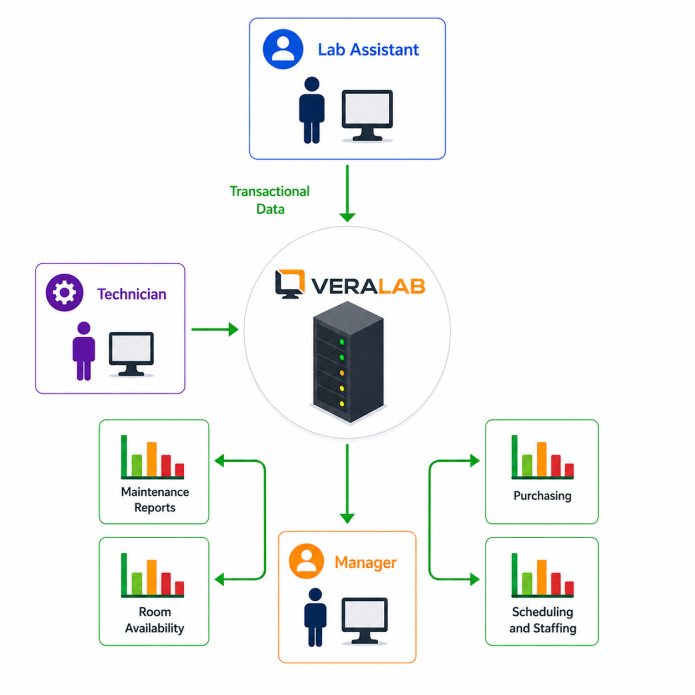
The decision support capabilities of VeraLab transform computer labs into data-driven, efficiently managed operations where strategic decisions are guided by real-time analytics rather than assumptions. Managers gain the visibility and operational intelligence needed to optimize staffing, scheduling, budgeting, purchasing, and infrastructure planning with greater accuracy, accountability, and confidence.